
Source (https://reddit.com/r/space/comments/x0d1ci/a_few_pics_of_nasas_artemis_rocket_scheduled_to/)
Originally scheduled to launch today but just delayed a few minutes ago.

Source (https://reddit.com/r/space/comments/x0d1ci/a_few_pics_of_nasas_artemis_rocket_scheduled_to/)
Originally scheduled to launch today but just delayed a few minutes ago.

“This slice of the vast universe is approximately the size of a grain of sand held at arm’s length by someone on the ground.”
“The combined mass of this galaxy cluster acts as a gravitational lens, magnifying more distant galaxies, including some seen when the universe was less than a billion years old.”
“This image shows the galaxy cluster SMACS 0723 as it appeared 4.6 billion years ago, with many more galaxies in front of and behind the cluster.”
Source (https://webbtelescope.org/contents/news-releases/2022/news-2022-038)

“The Worcester Red Sox have retrofitted a convenience/memorabilia shop at their home stadium for frictionless shopping.”
“Standard AI retrofitted the WooSox Market store, which sells snacks and sports memorabilia, using ceiling-mounted cameras and proprietary computer vision software which associates each shopper with the items they pick up. After adding their payment information to the Standard AI checkout app, customers can enter the store, select the items they want, and tap their phone to walk out.”
(https://chainstoreage.com/minor-league-team-debuts-baseballs-first-autonomous-store)
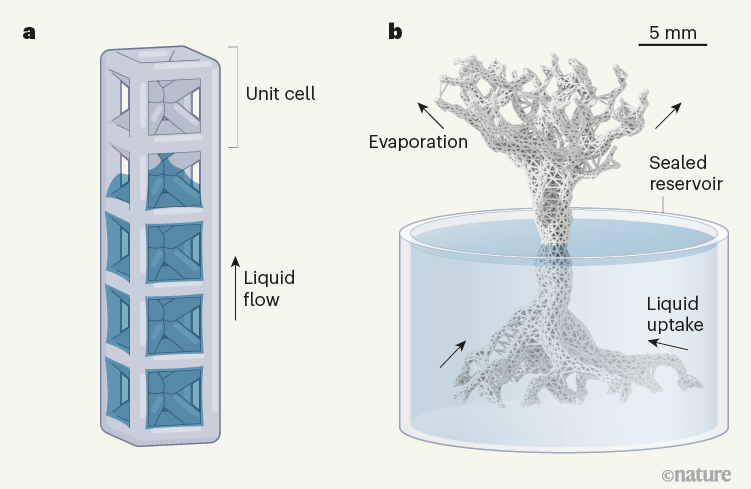
“A technological platform has been developed in which millimetre-scale cubes are assembled into 3D structures that control capillary action — enabling programmable fluid flows and modelling of a range of fluidic processes.”
“In this platform, millimetre-scale cubes known as unit cells have internal architectures that draw up fluids through capillary action. The combined capillary action of stacked unit cells produces a vertical flow of fluid.
“The authors report that a tree-like structure built from the unit cells continuously delivers liquid from a reservoir to the tips of the branches, where the liquid evaporates — a process that mimics transpiration in natural trees.”
“The flow of liquid in natural structures, such as tree leaves or soil, depends on the arrangement of the components in those structures3. Cellular fluidics is therefore the perfect tool with which to mimic such liquid flow, because the unit cells can be arranged in the same way as can the building blocks of the natural structures.”
“…the authors derived a theoretical model that describes how strut diameter and the number of cells coupled together influence the overall capillary action of a cellular fluidics system.”
Article (https://www.nature.com/articles/d41586-021-01708-2)
“At a price of about 20x its expected revenue in 2018 of about $400 million, the acquisition was unusually splashy for SAP; the CEO behind the deal, Bill McDermott announced his departure a few months later, insisting it was unrelated to activist investor Elliot Management taking a 1% stake in the company in the interim.
“More recently, Qualtrics has been seen by some analysts as one of the bright spots of SAP’s business, which has faced headwinds as companies grapple with the consequences of the spread of the Covid-19 pandemic. In a July 24 report, Cowen analyst J. Derrick Wood noted that a survey of 60 global SAP partner found that about three-quarters had missed their second-quarter sales targets as buyers delayed decisions and reduced the scope of certain projects. That’s especially hit business units like Concur, another former acquisition that makes travel and business expense software.
“But as businesses sell more online and need to track customers and employees remotely, SAP’s e-commerce units and Qualtrics have proven bright spots…”
“Once a buzzy expected IPO, will the public market embrace Qualtrics on a second go around? The company reported revenue of 161 million Euros, or about $188 million, for Q1 2020; when SAP reports earnings on Monday, analysts and potential investors will get to see the first full year-to-year quarterly results for the business, which said last quarter it had 11,600 customers and was not GAAP profitable.
“Medallia, another company that tracks customer engagement and experiences with online survey roots, reported revenue of $112.7 million in its last quarter, growth of 20%, and trades at a market capitalization of $4.2 billion, down 30% from its July 2019 high.”
(https://www.forbes.com/sites/alexkonrad/2020/07/26/sap-plans-to-spin-out-qualtrics-for-ipo)
Take retail as an industry. Physical retailers pay rent for good locations, expecting footfall to come their way. That rent payment is actually part of their customer acquisition cost.
In the digital world businesses don’t pay rent in the traditional sense, but customer acquisition still isn’t free. Getting your products in front of the right people online is essentially paying temporary rent – and Facebook, Instagram & Google have the biggest malls in town.
(https://www.chartr.co/newsletters/2020/7/3/keeping-up-with-the-kardashians)
“Tesla’s founder Elon Musk wiped $14bn off the carmaker’s value after tweeting that its share price was too high.”
January 2020:
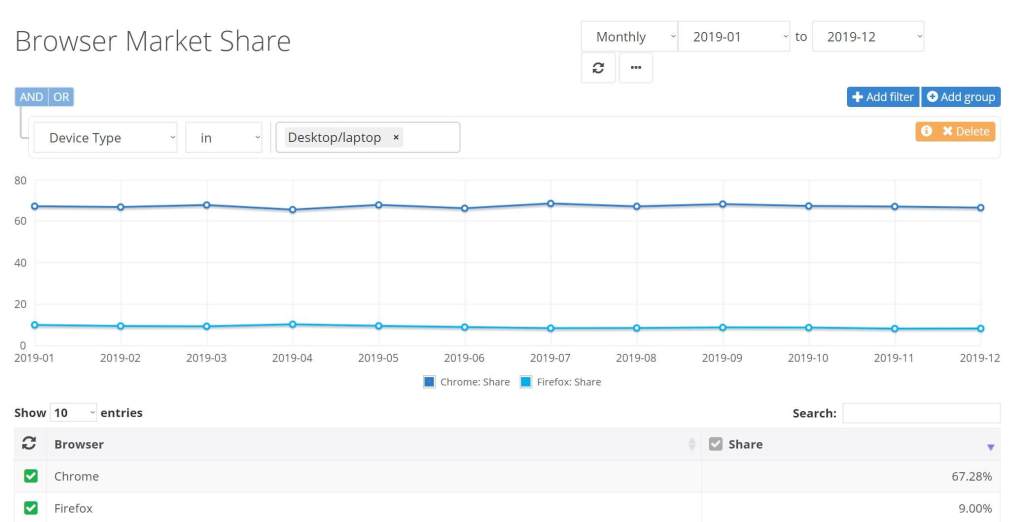
“Mozilla lays off 70 employees as its revenue declines”
“Mozilla still gets most of its money from global browser search partnerships, but its falling popularity has seen revenue decline in recent years, forcing it to look toward other sources.”
(https://www.techspot.com/news/83575-mozilla-lays-off-70-employees-revenue-declines.html)
April 2020:
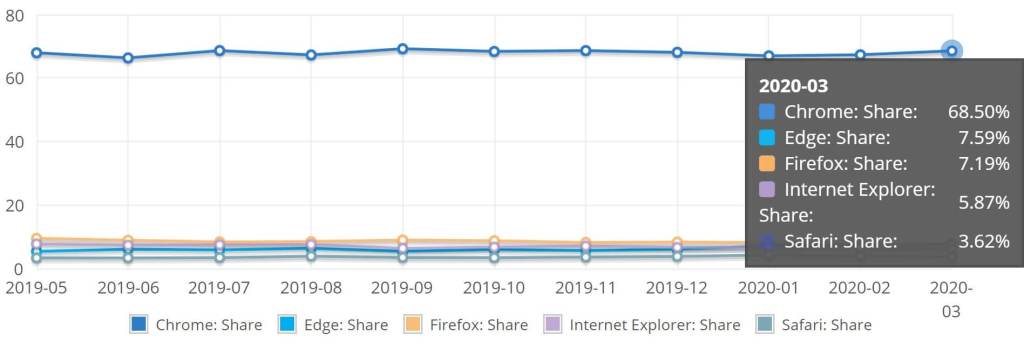
“Microsoft Edge overtakes Firefox as the second most popular browser”
“Xerox announced today that it would be dropping its hostile takeover bid of HP. The drama began last fall with a flurry of increasingly angry letters between the two companies, and confrontational actions from Xerox, including an attempt to take over the HP board that had rejected its takeover overtures.
“All that came crashing to the ground today when Xerox officially announced it was backing down amid worldwide economic uncertainty related to the COVID-19 pandemic. The company also indicated it was dropping its bid to take over the board.”
(https://techcrunch.com/2020/03/31/xerox-drops-34b-hp-take-over-bid-amid-covid-19-uncertainty/)
“The incident immediately became an international whodunit: Who would dare to hack the Olympics? The Pyeongchang cyberattack would turn out to be perhaps the most deceptive hacking operation in history, using the most sophisticated means ever seen to confound the forensic analysts searching for its culprit.
“The difficulty of proving the source of an attack—the so-called attribution problem—has plagued cybersecurity since practically the dawn of the internet. Sophisticated hackers can route their connections through circuitous proxies and blind alleys, making it almost impossible to follow their tracks. Forensic analysts have nonetheless learned how to determine hackers’ identities by other means, tying together clues in code, infrastructure connections, and political motivations.
“In the past few years, however, state-sponsored cyberspies and saboteurs have increasingly experimented with another trick: planting false flags. Those evolving acts of deception, designed to throw off both security analysts and the public, have given rise to fraudulent narratives about hackers’ identities that are difficult to dispel, even after governments announce the official findings of their intelligence agencies. It doesn’t help that those official findings often arrive weeks or months later, with the most convincing evidence redacted to preserve secret investigative techniques and sources.”
“At the end of his long chain of internet-address connections, Matonis had found a fingerprint that linked the Olympics attackers back to a hacking operation that directly targeted the 2016 US election. Not only had he solved the whodunit of Olympic Destroyer’s origin, he’d gone further, showing that the culprit had been implicated in the most notorious hacking campaign ever to hit the American political system.”
“Olympic Destroyer was the first time someone used false flags of that kind of sophistication in a significant, national-security-relevant attack,” Healey says. “It’s a harbinger of what the conflicts of the future might look like.”
“As the 2020 election approaches, Olympic Destroyer shows that Russia has only advanced its deception techniques—graduating from flimsy cover stories to the most sophisticated planted digital fingerprints ever seen. And if they can fool even a few researchers or reporters, they can sow even more of the public confusion that misled the American electorate in 2016. “The question is one of audience,” Hultquist says. “The problem is that the US government may never say a thing, and within 24 hours, the damage is done. The public was the audience in the first place.”
(https://www.wired.com/story/untold-story-2018-olympics-destroyer-cyberattack/)
 danelabonte