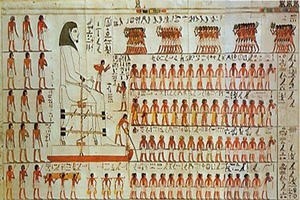
Ancient Egyptians reduced the friction of the sand with water to transport the colossal stones used to build the pyramids
When the sand was dry, a heap of sand formed in front of the sled, hindering its movement. Adding water made the sand more rigid, and the heaps decreased in size until no heap formed in front of the moving sled.
Other researchers say that Egyptians also used desert clay as a lubricant.
Thin tafla clay layers have been seen under multi-ton blocks either left in place at the wall of a temple or other monument, or where workers left the blocks en-route, and not yet in their intended place in a building.
On the pyramid casings, the builders used millimeters-thin layers of whitish-pink gypsum mortar – finer even than Tafla, to make the final slide and adjustment into fits with an adjacent block so fine, you cannot get a knife or even a razor blade in between.
Sand could have been used for longer, coarser movements. Tafla, being fine, would have been used for shorter, more precise movements and adjustments whereas gypsum mortar, possibly even finer than talfa, would have been used for the most precise adjustments – setting the outer casing stones.
 danelabonte