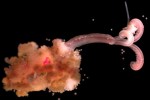

Bone-Eating Worms
Lurking deep in the world’s oceans, eyeless, mouthless, stomachless worms feast on the bones of whales and all manner of dead sea creatures. Boneworms, of the genus Osedax, are about 3 centimetres long and were first discovered on a whale carcass in 2002. The worms begin as microscopic larvae that drift through the dark water, using chemical cues to locate carcasses on the sea floor. They settle on the bones and begin to grow: one end grows into feathery appendages that extract oxygen from the water, and the other end grows into root-like appendages that dig a cavity in the bone and insert themselves like tiny blades of grass. Acid-secreting enzymes are abundant in these roots, and the acid breaks down the bone and allows the worm to digest proteins and lipids. However, only females develop to adult size: males are only 1 millimetre and attach themselves to the females for the sole purpose of fertilising her eggs—then the new larvae drift off to find more bones, and the lifecycle begins again. Researchers have determined that there are more than 15 different types of boneworm within the Osedax genus, and have hypothesised that the worms may have evolved 45 million years ago, about the same time as the first open-ocean whales, or 130 million years ago, during the age of the dinosaurs when immense reptiles roamed the seas.
It’s amazing that we can know so much about such a small creature that was discovered so recently.
 danelabonte